
pool owners hub
How to Get Your Pool Ready for Summer in Queensland
Queensland summers are long, hot, and hard on pools. Between October and April, pool temperatures climb, bather loads surge, and UV levels accelerate chlorine consumption to a rate that can overwhelm systems set up for the quieter months. The pools that handle summer well are the ones prepared before it arrives — not the ones trying to catch up in the middle of it.

Why Queensland Summers Are Hard on Pools
UV intensity: Higher UV in summer breaks down chlorine faster. Without adequate stabiliser, you can lose a full chlorine dose within 2–3 hours of direct sunlight.
Water temperature: Warm water (above 28°C, common from November through March) accelerates bacterial growth and algae reproduction. Higher temperature means higher chlorine demand.
Bather load: School holidays and increased pool use means more sweat, sunscreen, body oils and organic material — all consuming chlorine.
Rainfall: Summer is storm season in South-East Queensland. Heavy rain dilutes chemical levels, drops alkalinity and pH, introduces phosphates from runoff, and can significantly reduce stabiliser levels.
Start Early: The Pre-Summer Checklist
The ideal time to prepare your pool for summer is September — before the heat arrives and before service schedules get busy. Complete these checks before October:
Water chemistry baseline:
Get a full professional water test. Adjust any parameters outside range before summer demand increases. Pay particular attention to CYA (if below 30 ppm, chlorine will burn off rapidly in summer heat; if above 80 ppm, address with a partial drain before the season). Check phosphate levels — if above 300 ppb, treat with phosphate remover before algae season.
Salt level (saltwater pools):
Test and adjust to the middle of your chlorinator's recommended range. You'll lose some to dilution during summer rain events, so starting at mid-range gives you a buffer.
Chlorinator output:
Increase output setting for summer. A setting adequate for winter will often be insufficient in summer. A common adjustment is increasing output by 20–30% from your winter setting.
Equipment Check Before Summer
Summer is not the time to discover your pump is struggling or your filter needs a service. Run through this equipment checklist in September:
Pump:
Is the pump priming properly and running quietly?
Any signs of leaking from the pump body or unions?
Good flow returning to the pool through the return jets?
Filter:
When did you last backwash (sand/glass) or clean (cartridge)?
Is the pressure gauge reading in normal range?
Sand and glass media older than 7 years should be replaced before summer.
Salt chlorinator cell:
Inspect and clean the cell if any scale is visible.
Check display for warning codes.
If the cell is more than five years old, have it tested for output efficiency.
Pump run times:
Adjust for summer — minimum 8 hours per day; 10–12 hours is better during peak months.
Water Chemistry for Summer
During summer, tighten your chemical management:
Free chlorine: Maintain 2–3 ppm (saltwater) or 2–4 ppm (manual dosing). Do not let chlorine drop to zero — recovery from an algae event in summer heat is far harder than prevention.
pH: Keep tightly in the 7.2–7.4 range. pH tends to rise faster in warmer water and with heavy bather load.
Shock weekly: Even well-maintained pools benefit from a weekly shock during peak summer to break up chloramines from high bather load.
Test more frequently: Two to three times per week rather than weekly.
Managing Bather Load
A pool swum in heavily on Saturday will often need attention on Sunday. Key practices:
Shock after heavy use — after a pool party or school holiday weekend
Encourage swimmers to shower before entering — reduces organic load substantially
Check and empty skimmer baskets daily during high-use periods
Test chlorine and pH the morning after any heavy use event
Keeping Up During the Peak Season
Keep chemicals on hand.
Running out of chlorine on a Friday night means a green pool by Monday morning. Stock up before the season — particularly chlorine, pH reducer (summers tend to push pH up) and algaecide.
Don't skip testing after rain.
Significant rainfall is the most common trigger for green pools in summer. Test within 24 hours of any heavy rain and adjust — especially alkalinity, pH and stabiliser.
Watch the pool daily.
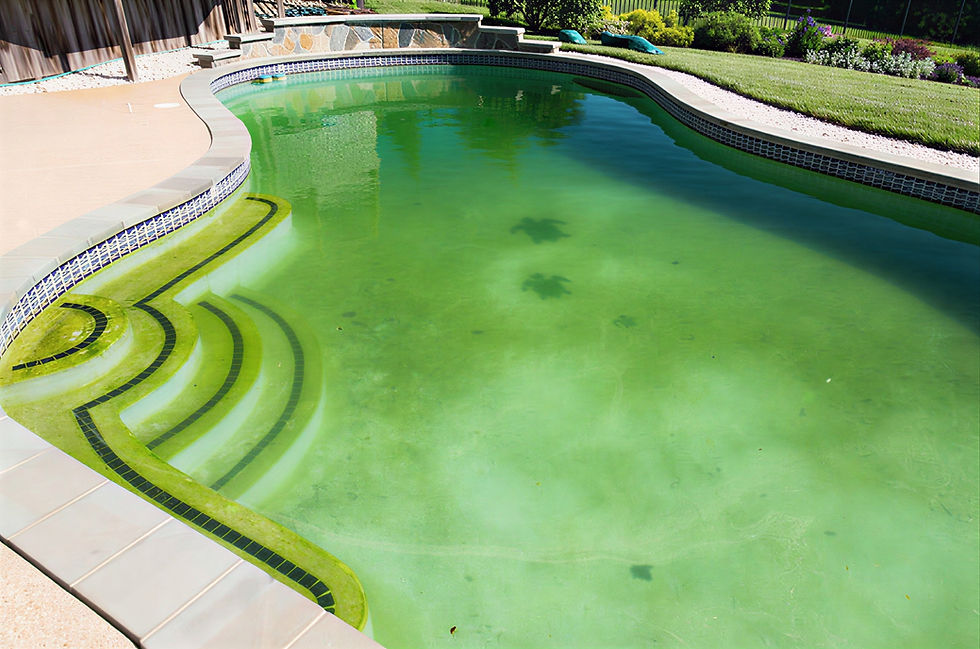
A slight haziness at the deep end, or a faint green tint noticed at night, is early-stage algae. Catch it now and a dose of algaecide and shock is sufficient. Wait two days and you're doing a full green pool recovery.
Signs Your Pool Needs Professional Attention in Summer
Water is hazy despite apparently correct chemical levels — may indicate a CYA or phosphate problem
Pool won't hold chlorine even with increased dosing — CYA may be too high
Recurring algae despite treatment — often a phosphate or circulation issue
Equipment issues — reduced flow, pump noise, filter pressure rising quickly
Summer is the busiest period for pool service teams. If you think something is wrong, call early — a small problem in November is much easier to address than a full green pool crisis in January. Atlantis Pool Services covers the North Brisbane and Moreton Bay region — call (07) 3491 9700 to book a pre-summer service.


.jpg)