
pool owners hub
How to Test and Balance Your Pool Water
Clear, balanced water doesn't happen by itself. Behind every sparkling pool is a consistent testing and adjustment routine. The good news is that once you understand what you're testing for and why each measurement matters, pool water chemistry becomes a lot less intimidating.
This guide covers everything you need to know to test and balance your pool water correctly — what the numbers mean, how to adjust them, and when it's worth calling a professional.

Why Testing Matters
Pool water chemistry is dynamic. Temperature, rainfall, bather load, sunlight and even the chemicals you add all shift the balance. A pool that tested perfectly on Tuesday may need attention by Friday after a hot weekend of swimming.
Residential swimming pool testing regularly every month during summer and winter — catches small imbalances before they become expensive problems. Algae, cloudiness, equipment corrosion and skin irritation are almost all the result of chemistry that drifted out of range without being caught early enough.
What You're Testing For
There are six core measurements every pool owner should understand:
Free Chlorine (FC)
The active sanitiser in your pool — the chlorine doing the work of killing bacteria and oxidising contaminants. Recommended range: 2–3 ppm for saltwater pools in Queensland; 1–3 ppm for manually dosed chlorine pools.
pH
pH measures how acidic or alkaline your water is. The ideal range is 7.2–7.6. Above 7.8, chlorine efficiency drops significantly and scale can form. Below 7.2, eye and skin irritation increase and equipment can corrode.
Total Alkalinity (TA)
Alkalinity acts as a pH buffer — it prevents pH from swinging dramatically when you add chemicals. Ideal range: 80–120 ppm. Low alkalinity makes pH unstable; high alkalinity makes it sluggish to adjust.
Calcium Hardness (CH)
Measures dissolved calcium in your water. Too low and the water becomes corrosive, attacking pool surfaces and equipment. Too high and scale forms. Ideal range: 200–400 ppm.
Cyanuric Acid (CYA) / Stabiliser
CYA protects chlorine from UV sunlight. Without it, outdoor pools lose chlorine rapidly. Ideal range: 30–50 ppm. Above 80–100 ppm, chlorine is effectively locked up — a condition called chlorine lock.
Salt Level (salt mineral pools)
Most salt chlorinators operate best at 3,000–5,000 ppm. Check your chlorinator's manual for its specific recommended range.
Mineral Pools between 1500 to 6000 ppm, check your chlorinator manual for specific recommended range.
How to Take a Water Sample
For accurate results, take your sample from elbow depth — not from the surface (where chemicals concentrate) and not from in front of a return jet (which doesn't represent the pool as a whole). Mid-pool, elbow depth is the standard.
If bringing a sample to a pool shop, use a clean 500ml swimming pool water specimen sample bottle from our pool shop and bring it within 30 minutes of collection for best accuracy.
How to Read Your Test Results
Strip tests are fast but less accurate. Liquid drop test kits give much more reliable readings for pH, chlorine and alkalinity. Digital testers are the most accurate but require calibration.
For the most reliable results — particularly if you're troubleshooting a problem — bring a sample to a professional. Our North Lakes shop tests all six parameters and provides a plain-language explanation and action plan.
How to Adjust Your Water Chemistry
The order of adjustments matters. Always adjust in this sequence:
Total Alkalinity - alkalinity is the foundation; get this right and pH is easier to control
Ph
Chlorine
Calcium - in spring only
Salt
Stabiliser - especially during summer
phosphates
Copper
Wait at least an hour between adding different chemicals, and always add chemicals to water (not water to chemicals). Never add two chemicals at the same time.
Raising alkalinity and pH: Sodium bicarbonate
Lowering alkalinity or pH: Dry acid or Hydrochloric Acid
Raising calcium hardness: Calcium chloride
Raising CYA: Isocyanuric acid — dissolve fully before adding
How Often Should You Test?
After heavy rain or high bather load - add acid, except on occasions of acid rainfall and when the sun comes out add extra chlorine to the fresh water or heavy bather load than usual.
After heavy rain or high bather load - add acid, except on occasions of acid rainfall and when the sun comes out add extra chlorine to the fresh water or heavy bather load than usual.
Winter (May–September): monthly is usually sufficient
After heavy rain: test immediately — rainfall dilutes chemical levels significantly
After a party or high bather load: test the following day and shock if as required to increase chlorine levels
When to Call a Professional
Some situations benefit from professional assessment rather than DIY troubleshooting:
Water that remains cloudy despite correct chemical levels — may indicate a filtration issue
Recurring algae despite regular chlorination — may indicate a CYA problem or circulation issue
Persistent pH instability — may indicate very low alkalinity or a carbonate balance issue
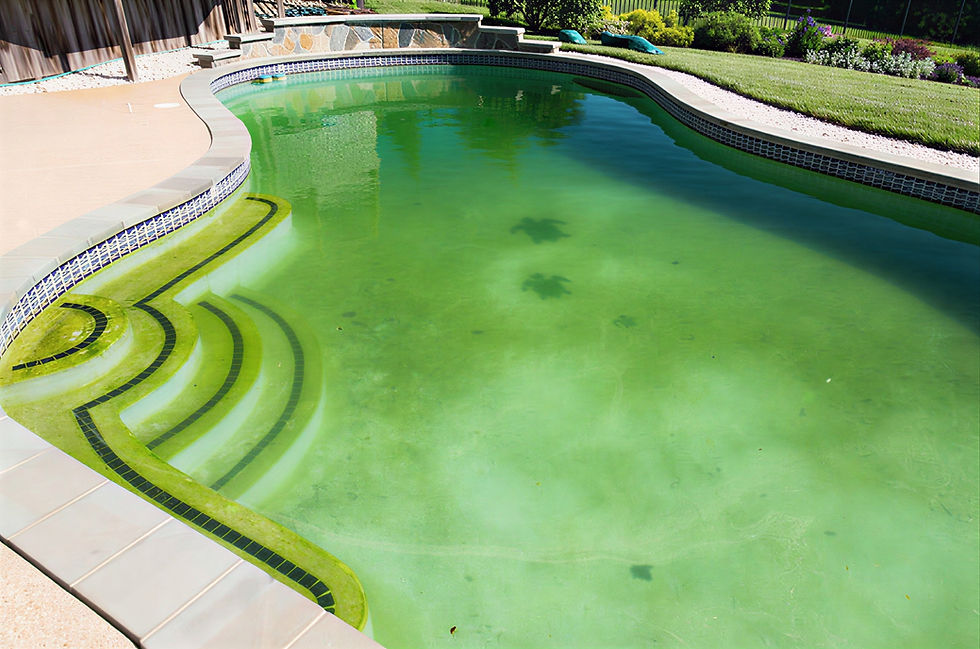
Green water that doesn't respond to shock treatment within 48 hours
At Atlantis Pool Services, we offer professional water testing at our North Lakes shop at 73 Stapylton Street. Bring in a sample and we'll test all parameters on the spot and give you a clear action plan. Call (07) 3491 9700 to book an on-site water test.


.jpg)

