
pool owners hub
Pool Chemistry 101: What Every Pool Owner Should Know
Pool water chemistry sounds complicated until you understand what each parameter does and why it matters. Once you see the connections, the whole system makes sense. This guide covers the six key measurements that determine whether your pool water is clean, safe and comfortable — and how they interact.

The Key Numbers: Your Reference Targets
Free Chlorine: 1–3 ppm (2–3 ppm for saltwater pools in Queensland)
pH: 7.2–7.6
Total Alkalinity: 80–120 ppm
Calcium Hardness: 200–400 ppm
Cyanuric Acid (CYA): 30–50 ppm
Salt (saltwater pools): 3,000–5,000 ppm (check chlorinator specs)
Memorise these ranges. They're the foundation of everything else.
Chlorine: The Workhorse
"Chlorine" as a concept includes several different things:
Free chlorine (FC): The active, working chlorine. This is what you're measuring when you test.
Combined chlorine (CC): Chlorine that has bound to contaminants (ammonia from sweat and body care products). No longer sanitising. High combined chlorine causes the "chlorine smell" — it's not excess chlorine, it's spent chlorine.
Total chlorine: Free + combined chlorine.
The goal is high free chlorine and near-zero combined chlorine. When combined chlorine rises above 0.5 ppm, shock (superchlorinate) the pool to break up the chloramines. In water, chlorine forms hypochlorous acid (the active sanitiser) — the ratio is determined by pH, which is why pH management is so critical.
pH: The Balance Point
pH is the most important parameter in pool management because it affects everything else. The 7.2–7.6 range is ideal for three reasons:
Chlorine effectiveness: At pH 7.0, roughly 70% of chlorine is in its active form. At pH 7.8, only 30% is active. At pH 8.0, less than 20%.
Swimmer comfort: The pH of the human eye is approximately 7.4. Water in the 7.2–7.6 range is comfortable. Water outside this range causes irritation.
Equipment protection: Low pH corrodes metal fittings and pool surfaces. High pH causes scale.
What raises pH: rainfall, high bather load, liquid chlorine, calcium hypochlorite. What lowers pH: carbon dioxide (from heavy aeration), dry acid, muriatic acid. pH changes frequently and requires regular monitoring.
Total Alkalinity: The Buffer
Total alkalinity (TA) is often confused with pH, but it's different. Alkalinity measures the water's capacity to resist changes in pH — its buffering ability.
Low alkalinity (below 60 ppm): pH becomes unstable; small additions of acid or base cause large swings. High alkalinity (above 140 ppm): pH becomes sluggish; hard to adjust even with acid. Scale formation risk increases.
To raise: sodium bicarbonate. To lower: dry acid or muriatic acid, added in the deep end with pump running. Always adjust alkalinity before adjusting pH.
Calcium Hardness
Water wants to reach equilibrium. If it contains insufficient calcium, it will leach it from wherever it can — pool plaster, grout, equipment. This aggressive water causes surface etching and corrosion. Too much calcium and the water deposits scale on surfaces, in pipes, on salt cells and heat exchangers.
To raise: calcium chloride (add slowly — generates heat). To lower: partial drain and refill. Unlike chlorine and pH, calcium hardness changes slowly. Check monthly, adjust quarterly.
Cyanuric Acid: The Protector
UV light destroys chlorine. In a Queensland summer, an unstabilised outdoor pool can lose its entire chlorine dose in a few hours of direct sunlight. CYA forms a bond with chlorine that protects it from UV degradation. At 30–50 ppm, CYA extends chlorine life significantly without substantially reducing sanitising power.
The problem with high CYA: As CYA increases, the amount of active (free) chlorine decreases even if your test reads a normal level. Above 80–100 ppm, you may need to maintain 6–8 ppm chlorine to get the same sanitising effect as 2–3 ppm with correct CYA. This is called chlorine lock.
There is no chemical to lower CYA — the only solution is partial drain and refill. Pools using stabilised chlorine products (trichlor tablets, dichlor granules) build up CYA over time. Switching to unstabilised chlorine and occasional partial drains keeps CYA in range.
Phosphates: The Often-Ignored Variable
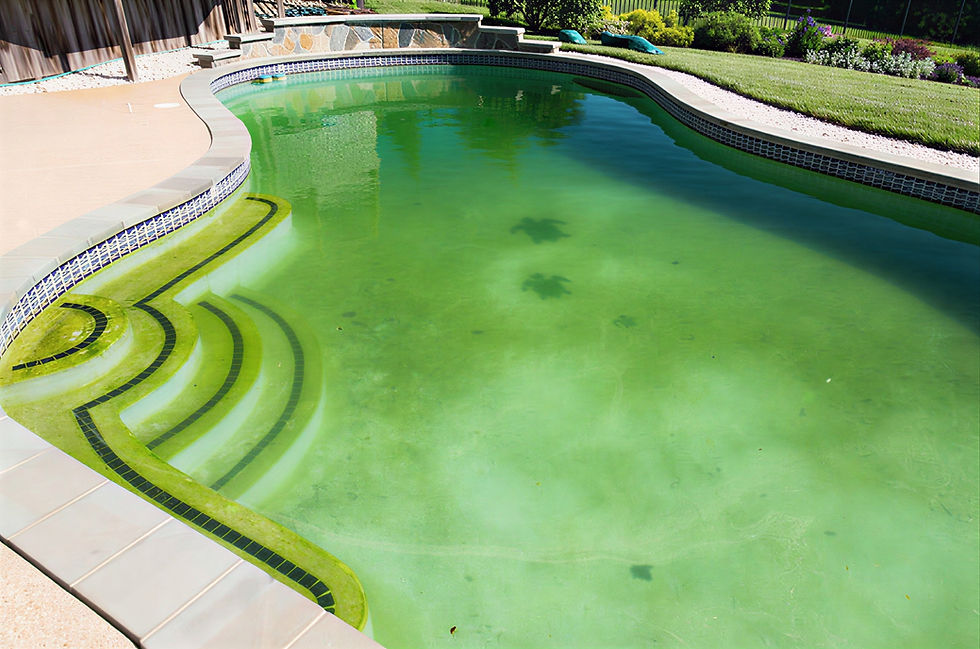
Phosphates don't directly harm pool water but they fuel algae growth. Pools with phosphate levels above 300–500 ppb are significantly more prone to algae problems even with correct chlorine levels. Phosphates enter pools from leaves and garden debris, some pool chemicals, tap water, sunscreen and body care products, and fertiliser runoff. Phosphate remover (lanthanum carbonate-based products) removes them effectively.
How It All Interacts: The System View
pH affects how effective chlorine is
Alkalinity affects how stable pH is
CYA affects how much free chlorine is actually available
Calcium hardness affects whether scale or corrosion occurs
Phosphates affect how quickly algae can exploit any chlorine deficit
A pool with perfect chlorine but wrong pH is under-sanitised. A pool with perfect chlorine but high CYA may have insufficient active chlorine. Managing a pool well means managing the whole system, not just one parameter.
The Most Common Mistakes
Adding chlorine without testing pH first — chlorine added to a high-pH pool is largely ineffective
Letting CYA accumulate without partial drains — leads to chlorine lock
Testing with strips only — strips don't measure CYA or calcium, and are less accurate on pH and chlorine
Treating symptoms rather than causes — adding clarifier to cloudy water without finding out why it's cloudy
Adding multiple chemicals at once — always wait at least an hour between different additions
For a professional water test covering all six parameters with a plain-language action plan, bring a sample to Atlantis Pool Services at 73 Stapylton Street North Lakes. Call (07) 3491 9700.


.jpg)

